
Roadmap for Transformation
The Apex Architecture
A blueprint for internal congruence. Most performance issues are not failures of will, but failures of structural integrity.
The Pillars of Stability
For any goal (the Apex) to be sustainable, it must be supported by three balanced pillars. If one pillar is weak, the entire structure leans, creating the internal friction that we experience as stress or procrastination.
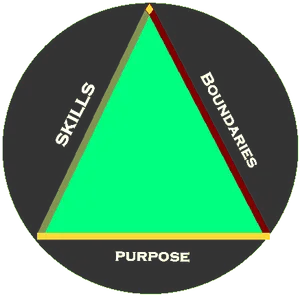
1. Foundation (Purpose, The "Why")
This is the immovable vision that directs your skills and is protected by your boundaries. Without a rooted purpose, the structure has no ground to sit on.
2. Skills (The "How")
Cognitive Craftsmanship. We treat the subconscious mind as the Master Mason, sharpening the tools needed to build the goal with precision and ease.
3. Boundaries (The "What")
Defining the Perimeter. We define the scope of the goal to keep energy focused upward, shielding you from distractions and "scope creep."
The Result: Structural Equilibrium
Beyond the Limits of Willpower
By auditing these three pillars, we identify exactly where the friction lies. We don't just "try harder"—we fix the architecture.
The Apex
The goal or manifestation. When the Foundation, Skills, and Boundaries meet, the Apex becomes a structural inevitability rather than just a wish.
The Core
Represents the growth fuelled by your Purpose. It results in a steady-state of equilibrium between your "Inside" intentions and your "Outside" actions.
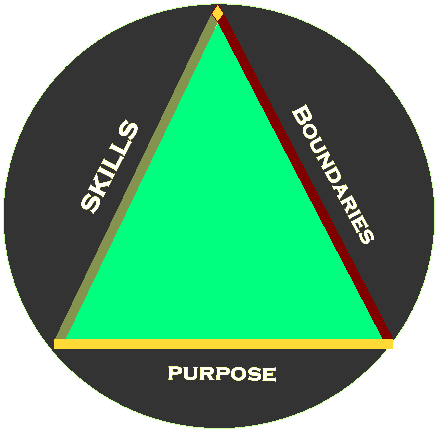
The Apex Architecture in Practice
Metaphor: Building a House
Purpose: The Foundation. Before sourcing materials or hiring expertise, you must establish the immovable intent—the "Safe Home." Without this, the structure has no ground to stand on.
Skills: The Craftsmanship. These are your tools and technical mastery. It is the ability to ensure the walls are straight and the structural integrity is sound.
Boundaries: The Perimeter. These are the external walls and locks. They define the shape of the house, insulating the interior from the "weather" and uninvited noise.
The Apex: The Roofline. The highest point where the pillars meet. It represents the "Finished Shelter"—the completion of the protective form.
The Core: The Life of the House. The expansion of vitality within the walls. This is the creative energy that turns a structure into a home.
Case Study: Public Speaking
Purpose: The Intentional Anchor. If your purpose is to inspire, it serves as your stable ground. Without a rooted intention, you are simply a voice in a room; with it, you are an authority.
Skills: Subconscious Composure. The ability to maintain a regulated nervous system under the spotlight. These are the cognitive tools required for a decisive delivery.
Boundaries: Strategic Containment. Defining the perimeter of your talk. By focusing exclusively on key pillars, you insulate your performance against "scope creep" and audience judgment.
The Apex: The Result. The Successful Keynote. The point where your preparation meets the room’s energy in total congruence.
The Core: Presence. The expansion of personal presence—the transition from performing a role to embodying a state.